Iskra Velitchkova

Can machines make us more human?

Distance. Emergence. New landscapes.

Distance

The central theme of my work is distance—an evolving concept in our contemporary world. Today, we navigate distances that are no longer purely physical. Just as trains and planes once redefined our sense of proximity, our immersion in vast networks of information, data, and computation is reshaping how we relate to one another, creating new forms of distance.

Consider how we evaluate books, films, music, or any form of content today—often through metrics that simplify and quantify our preferences. Dating apps operate in a similar way, acting as massive databases that filter and categorize potential connections, bringing people closer in a way that would have once taken a lifetime. This is just one example of how technology compresses distance, whether in relationships, culture, or access to knowledge.

But what happens when we, as artists, disrupt these systems? What if we break these new ways of processing information and reshape our understanding of distance once again?

I. Emergence

A second self and a shared will.

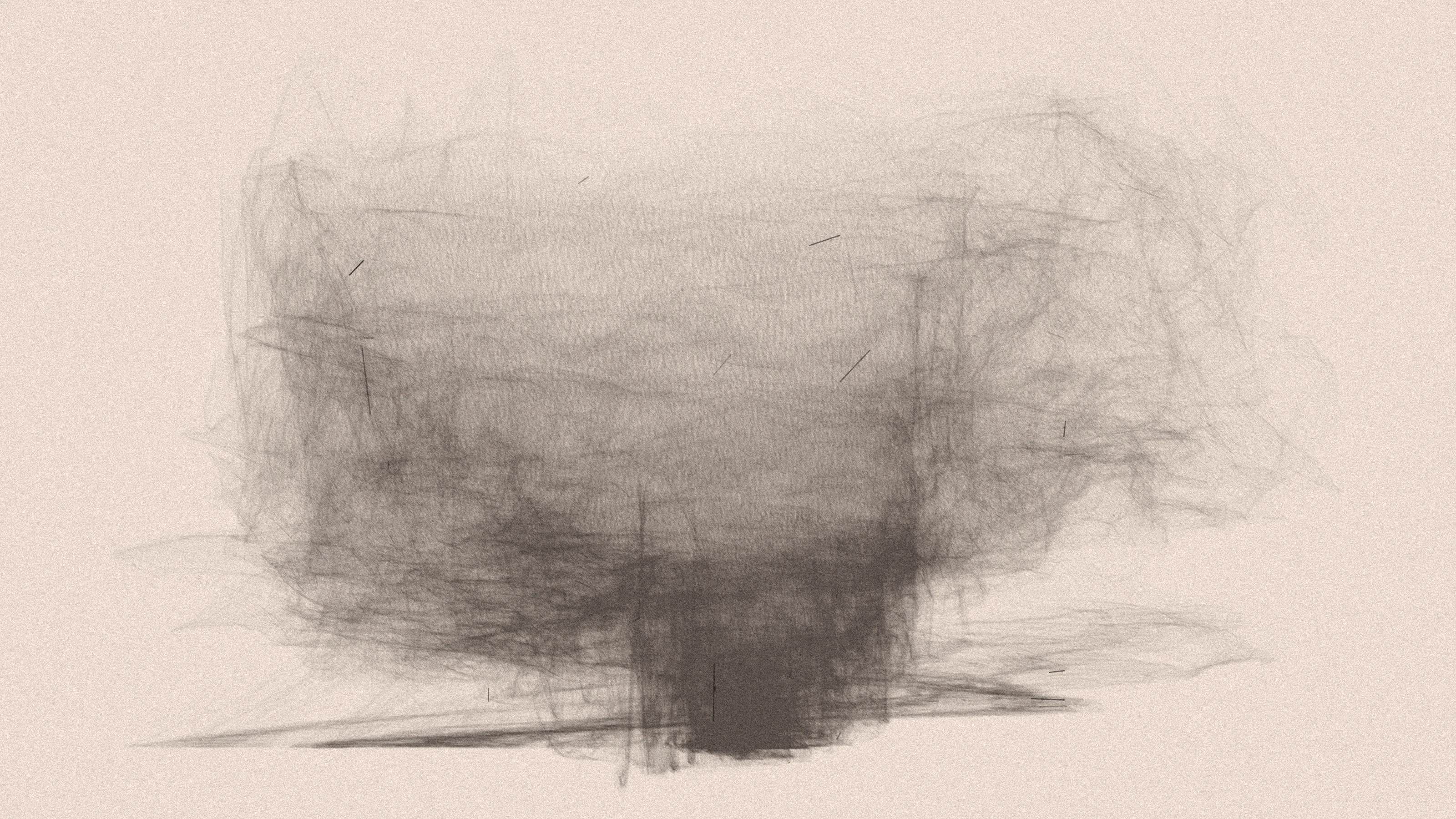
I explore the emergence of a second self in generative art. When you create rules and are surprised by your own rules, you initiate a conversation with a parallel version of yourself. It’s you, but not quite. You’re not you, but you are. In my view, this represents a fundamental shift in the history of artistic creation.

II. New landscapes

Contemplating contemporary landscapes, I question whether the era of information and new distances can more rigorously reflect our intuitive origins. The history of art teaches us that humans have always reflected on their surroundings to understand them. However, what has always propelled us forward —and always will— is the desire to understand who we are within those surroundings.

From cave paintings to religious art, from naval battles to Sunday scenes, landscapes, and portraits—technology has always shaped artistic expression. The emergence of transportation allowed us to paint new horizons. The invention of new pigments enabled more accurate representations of reality. The application of science introduced correct perspectives. Photography forced abstraction.

Are we a black canvas on a white background? Are we green shadows, cubic sculptures, or a particular shade of blue? Who knows — perhaps we are all of these. Yet this search for truth has always been guided by intuition.

I ask myself: What are the new landscapes of today? Having painted everything we can see and represented everything we cannot, we now find ourselves at a moment where this era — the era of information, new distances, and new responses to old questions—can more rigorously reflect what we intuitively perceive. Today, in a world where we create alongside this second self, are these emerging forms in artworks guiding us toward answers? What happens when a combination of random parameters results in a human figure? What is the distance between this emergent figure and a real one? Could this be another way to get closer to the essence of everything? I am certain that we are facing new landscapes, and I am curious to see what we will discover in them.

III. Physical is not the opposite of digital

I challenge the notion that digital art opposes physical art. In generative art, technology is not just a tool—it is a source of inspiration, shaping both the landscape and the object of creation. The presentation format, often inherent to the work, is merely a medium. The art can seamlessly translate into a physical form, emphasizing that its digital essence is fundamentally informational. Can technology, in a way, be nature communicating with us? Could art be the language it uses? Can machines make us more human?